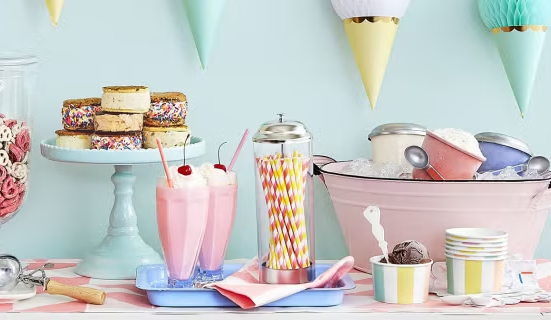
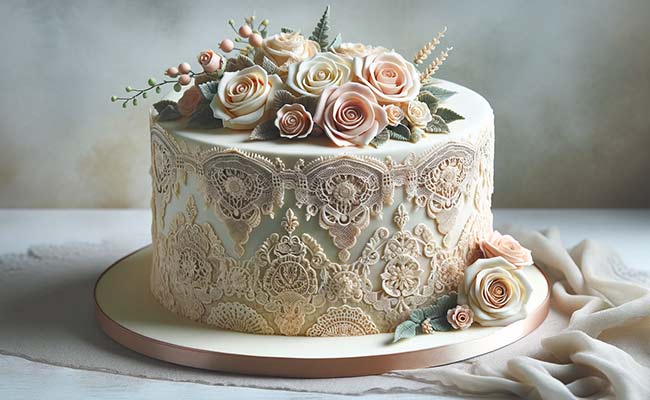
At a 1950s-themed anniversary party in Savannah in 2023, the baker produced a pale mint Swiss dot buttercream cake with hand-piped Cornella lace and sugar violet clusters — guests in their seventies teared up at the table because the cake looked exactly like the one from their own wedding photographs.
Vintage cake decorating is having one of its most sustained revivals in the history of American baking — not because it is fashionable, but because it produces something modern minimalism cannot: emotional resonance, visual warmth.
The vintage cake decorating aesthetic rewards patience and deliberate technique more than any other decorating style in the current market.
Why Vintage Cake Decorating Is Experiencing a Sustained Cultural Revival:
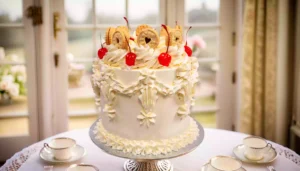
The return of vintage cake decorating is not a passing trend. It reflects a broader cultural shift toward authenticity, handcraft, and visual warmth in a market that spent most of the 2010s trending toward stark minimalism and architectural precision.
Pinterest data from 2023 shows that searches for “vintage cake,” “Lambeth cake,” and “Cornella lace cake” collectively grew over 180% between 2020 and 2023, outpacing the growth of almost every other specific cake aesthetic category. Wedding industry publications including Martha Stewart Weddings and Brides have featured vintage cake decorating styles on covers and in editorial features with increasing frequency since 2021. The style is not niche. It is mainstream, and the decorators who develop genuine fluency in it are competing in a market where demand currently exceeds supply of qualified practitioners.
Vintage cake decorating encompasses a specific set of techniques with documented historical origins: Lambeth over-piping from early twentieth century English confectionery, Swiss dot and curtain piping from American home baking culture of the 1950s and 1960s, Cornella lace and broderie anglicize from continental European decorating traditions, and elaborate royal icing extension work from Victorian-era sugar craft. Each of these techniques has specific material requirements, learning curves, and visual vocabularies that distinguish professional vintage cake decorating from amateur attempts at a “retro look.”
The 5 Core Techniques That Define Vintage Cake Decorating:
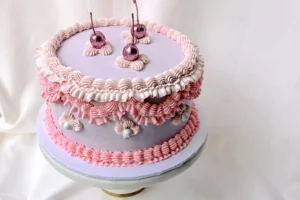
Vintage cake decorating is not a single technique — it is a family of related piped and modeled approaches, each with its own historical context and specific visual character. These five are the foundational vocabulary.
- Lambeth method over-piping — successive layers of piped royal icing elements placed on top of each other, building three-dimensional scrollwork and extension work that creates the dramatically dimensional, heavily embellished look associated with pre-1970s tiered cakes.
- Cornella lace — a continuous, irregular free-motion piped line in a tight, interlocking maze pattern; applied to cake surfaces with a fine round tip (number 1 or 2) to create a delicate lace texture that photographs with extraordinary detail under directional lighting.
- Swiss dot piping — small, individual dots piped in even rows across the cake surface, sometimes with tails (creating a Swiss dot swag pattern); among the most recognizable vintage cake decorating surface treatments in American midcentury baking.
- Broderie anglicize — an embroidery-inspired piped pattern using fine dots and oval outlines to replicate the eyelet needlework pattern popular on clothing and linens of the same era; applied to fondant surfaces using royal icing.
- String work and extension work — fine piped lines extending horizontally from the cake surface, often bridged between piped points on the tier side; the most technically demanding of all vintage cake decorating techniques and a hallmark of competition-level sugar art.
Royal Icing for Vintage Cake Decorating: Formula and Consistency Management:
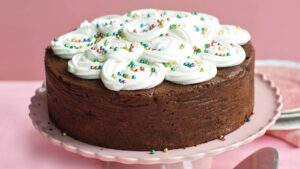
Royal icing is the primary medium for most vintage cake decorating techniques, and the consistency management of this medium is where the difference between competent and professional-level vintage cake decorating is made. Getting royal icing right requires understanding it as a material with precise consistency states, each appropriate to specific applications.
Royal icing at the wrong consistency for the intended technique produces failures that no piping skill can compensate for. Cornella lace piped with flood-consistency royal icing collapses immediately. String work attempted with stiff peak royal icing snaps rather than flowing cleanly between anchor points. The relationship between consistency and technique in vintage cake decorating is non-negotiable.
1: Making Royal Icing for Piping
The base formula for piping-consistency royal icing: 3 tablespoons of meringue powder (not raw egg whites, which carry food safety concerns for displayed cake surfaces) combined with 6 tablespoons of water, mixed until foamy, then 1 pound of sifted confectioner’s sugar beaten in over three minutes at medium speed. The result at this ratio is stiff peak consistency — appropriate for Lambeth scrollwork and dimensional piped elements in vintage cake decorating but too stiff for fine line work like Cornella lace.
2: Adjusting Consistency for Different Vintage Cake Decorating Applications
For fine line vintage cake decorating techniques — Cornella lace, string work, swiss dot piping — thin the stiff peak royal icing by adding distilled water one teaspoon at a time, mixing thoroughly between each addition, until the icing flows off a spatula in a steady ribbon without breaking. This is medium peak consistency, and it is the correct state for 80% of surface piping in vintage cake decorating. For Lambeth over-piped elements that must hold their three-dimensional form, return to stiff peak. For flood-coating fondant surfaces before broderie anglicize, thin further to flood consistency — the icing levels itself within ten seconds of application.
3: Humidity and Temperature Effects on Royal Icing
Vintage cake decorating with royal icing is one of the most weather-sensitive decorating disciplines. Humidity above 65% slows drying times dramatically, which is critical for string work and extension work that must be set between each stage of construction. String work on a humid day in summer collapses before it sets. Cornella lace applied in high humidity softens and loses the crisp edge definition that makes the technique visually effective. Professional vintage cake decorating practice includes a hygrometer in the decorating space — a $12 investment that prevents $200 cakes from developing surface degradation before delivery.
Color Palettes That Define the Vintage Cake Decorating Aesthetic:
The wrong color palette can make technically excellent vintage cake decorating look merely retro rather than genuinely timelessly beautiful. These five palette directions are the correct reference points for authentic vintage aesthetic execution.
- Dusty blush and warm ivory — the defining palette of 1950s American wedding cake culture; achieved with a small amount of dusty rose gel coloring in an ivory-based American or Swiss meringue buttercream that never approaches white.
- Pale sage green and cream — the Continental European vintage cake decorating palette; associated with Wedgwood ceramics and Victorian decorating traditions; refined and calm in a way that brighter greens cannot replicate.
- Lavender and antique white — a softly feminine vintage palette that suits anniversary, bridal shower, and tea party vintage cake decorating applications; the lavender must be de-saturated toward a dusty, ash-toned tone rather than bright purple.
- Pale duck egg blue — associated with 1960s American kitchen culture and the specific visual vocabulary of Tiffany-adjacent celebration aesthetics; pairs naturally with white piped decoration and silver drogue accents.
- Champagne and soft gold — the most formal vintage cake decorating palette direction; suited to wedding cakes and significant anniversary cakes where the vintage reference should read as luxurious rather than nostalgic.
Lambeth Method Vintage Cake Decorating: Step-by-Step Execution:
The Lambeth method is the most visually dramatic and most technically demanding direction within vintage cake decorating, named after Joseph Lambeth, the English confectioner whose 1934 book The Lambeth Method of Cake Decoration and Practical Pastries codified the over-piped scrollwork technique for professional and amateur bakers alike.
The fundamental principle of Lambeth vintage cake decorating is additive depth: each piped element is placed on top of or over a previously piped and set element, building dimensionality that creates genuine three-dimensional relief on the cake surface. The process requires patience because each layer must be fully set before the next is applied — typically 30–45 minutes at low humidity between stages.
1: Piping the Base Scrollwork Layer
Using stiff peak royal icing in a piping bag fitted with a number 2 or 4 open star tip, pipe curved C-scroll and S-scroll forms directly onto the fondant-covered tier surface in your planned arrangement. The spacing and scale of these base scrolls determine the entire character of the Lambeth vintage cake decorating arrangement — tight, small scrolls read as delicate and fine; larger, more open scrolls read as bold and confident. Allow each piped scroll to set for a minimum of 40 minutes before proceeding to the over-piping stage.
2: Over-Piping and Building Dimension
Return to the set base scrolls and pipe a second, slightly narrower scroll directly over the first — centered on the first scroll’s path, adding approximately 2mm of additional height to the arrangement. Repeat for a third layer with an even narrower tip, and a fourth with a fine writing tip. The result is a scroll that has built up four layers of piped royal icing depth, creating the dramatic relief that makes Lambeth vintage cake decorating instantly recognizable in photographs. This building process requires a fine tip, consistent pressure, and sufficient drying time between each layer — shortcutting any of these three variables produces collapsed or uneven work.
Cornella Lace and Swiss Dot Techniques for Vintage Cake Decorating:
Surface texture techniques — Cornella lace and Swiss dot piping — represent the most accessible entry points into professional vintage cake decorating for decorators who are building confidence with fine piping before attempting the full complexity of Lambeth over-piping.
- Tip selection for Cornella lace — a number 1 or 1.5 round tip produces the finest, most refined Cornella lace in vintage cake decorating; a number 2 tip produces slightly heavier lace appropriate for closer viewing distances or less formal applications.
- Wrist movement for Cornella — the continuous, interlocking maze path of Cornella lace is generated by a fluid wrist rotation rather than deliberate letter-by-letter direction changes; practice the motion on parchment for ten minutes before applying to a cake surface.
- Swiss dot spacing — dots in classic vintage cake decorating Swiss dot patterns are spaced at approximately 1.5 to 2 dot-widths apart in even rows; tighter spacing produces a heavier texture; wider spacing produces a more delicate, open-air pattern.
- Curtain drop variation — a vintage cake decorating technique where Swiss dots are piped in curved, descending rows that create the visual impression of gathered fabric or lace curtain hemlines draped across the tier sides.
- Color contrast in surface texture work — vintage cake decorating surface textures are most effective when the piped icing is one to two shades lighter or darker than the base frosting, creating a tone-on-tone depth rather than stark two-color contrast.
| Technique | Skill Level | Medium | Avg. Learning Time | Best Vintage Era Reference | Humidity Sensitivity |
| Swiss Dot Piping | Beginner | Royal icing or buttercream | 1–2 practice sessions | 1950s American | Low |
| Cornella Lace | Beginner–Intermediate | Royal icing | 2–4 practice sessions | Edwardian / 1960s | High |
| Lambeth Over-Piping | Advanced | Royal icing | 10–20 hours practice | 1920s–1940s English | Very High |
| Broderie Auglaize | Intermediate | Royal icing on fondant | 4–8 hours practice | Victorian / Edwardian | High |
| String Work / Extension | Expert | Royal icing | 20–40 hours practice | Victorian competition | Extreme |
| Basket Weave Piping | Intermediate | Buttercream or royal icing | 3–6 hours practice | 1950s–1970s American | Medium |
| Ruffled Ruche | Beginner–Intermediate | Fondant or buttercream | 2–4 hours practice | 1980s / Neo-Victorian | Low |
| Sugar Violet / Rose Clusters | Intermediate | Gum paste | 5–10 hours practice | Edwardian / 1950s | Low |
| Wafer Paper Ruffles | Beginner | Wafer paper | 1–2 hours | 2010s vintage revival | Medium |
| Cameo Medallions | Advanced | Gum paste / fondant | 10–20 hours practice | Victorian / Regency | Low |
Sugar Flowers for Vintage Cake Decorating: Which Varieties to Master First:
Sugar flowers are not universally associated with vintage cake decorating — but specific flower varieties carry immediate vintage aesthetic coding that makes them essential to the style. The choice of flower variety is as important as the piping technique it accompanies.
Violets, sweet peas, forget-me-nots, and small English garden roses are the signature flower forms of vintage cake decorating from the Edwardian period through the 1960s. Peonies and chrysanthemums coded toward a slightly more formal, 1940s Hollywood aesthetic. Large modern garden roses and ranunculus are associated with contemporary design rather than vintage references — a technically proficient sugar rose in a contemporary scale reads as modern on a vintage cake, disrupting the historical coherence.
1: Gum Paste Violets: The Defining Flower of Vintage Cake Decorating
Violets are small, five-petaled, deeply purple-to-lavender flowers that appear in clusters in nearly every major vintage cake decorating reference from the 1930s through the 1970s. Making sugar violets requires gum paste rolled to 1mm thickness, small petal cutters in teardrop form, and a ball tool pressed against each petal to create the natural cupped curvature. The center stamen detail — a tiny yellow staminate made from a thin gum paste thread — is what distinguishes a realistic violet from a flat, undifferentiated petal cluster. Violets dry within four hours and store in cardboard boxes for up to three weeks without any color or structural loss.
2: Piped Buttercream Roses for the 1950s Vintage Look
The piped buttercream rose — built on a flower nail using a number 104 or 103 petal tip — is the signature flower technique of American 1950s vintage cake decorating. It requires stiff-peak American buttercream, a flower nail that rotates freely under the piping hand, and the specific wrist rotation that builds each petal layer from the inside outward. The first ring of upright base petals, the second ring of open-facing middle petals, and the outer ring of fully open petals all require different piping angles — 75 degrees, 45 degrees, and 15 degrees respectively — and this angle progression is the technical variable most decorators learning vintage cake decorating get wrong initially.
Fondant Vs. Royal Icing Surfaces for Vintage Cake Decorating:
The choice of base surface medium dramatically affects which vintage cake decorating techniques are technically feasible and which visual outcomes are achievable.
- Royal icing on a royal icing-covered fruitcake — the traditional English base for Lambeth and string work vintage cake decorating; the hard, dry surface supports extension work and fine over-piping that soft surfaces cannot; requires a fruitcake base to prevent the cake from collapsing under the icing weight.
- Fondant as a working surface — modern vintage cake decorating almost universally uses fondant as the primary surface; it accepts Cornella lace and Swiss dot work cleanly, supports pressed sugar flower arrangements, and provides the smooth ground that makes tone-on-tone texture work visible.
- Smooth buttercream for accessible vintage designs — chilled Swiss meringue buttercream provides a workable surface for piped vintage techniques but requires a lower working temperature environment; string work is not viable on buttercream surfaces.
- Ganache as a base under fondant — a ganache-iced tier under fondant produces the sharpest possible corner edges for vintage cake decorating applications that use edge detail as a design element; the ganache creates structural rigidity that fondant over buttercream cannot match.
- Wafer paper extensions — contemporary vintage cake decorating sometimes incorporates wafer paper ruffles and overlays to approximate the look of historical extension work at a fraction of the technical complexity.
Building a Vintage Cake Decorating Practice Routine:
Vintage cake decorating requires more deliberate practice than any other decorating style precisely because so many of its defining techniques are fine-motor, consistency-dependent, and weather-sensitive. Building a practice routine before attempting these techniques on a finished cake is not optional for reliable results — it is professional standard practice.
The fundamental insight about practicing vintage cake decorating is that practice materials cost almost nothing. A sheet of parchment taped to a cutting board is a perfect practice surface for Cornella lace, Swiss dot piping, and Lambeth scrollwork. Royal icing scraped from the practice parchment is fully reusable. Thirty minutes of daily practice on parchment for two weeks builds more reliable vintage cake decorating muscle memory than the same thirty hours spread across finished cakes over six months.
1: Practice Sequence for Cornella Lace
Begin with a simple wrist-rotation exercise on parchment — continuous loops and curves without lifting the piping bag tip from the surface, focusing exclusively on consistent line weight and smooth transitions. Ten minutes of this exercise at the start of each vintage cake decorating practice session builds the motor fluency that Cornella lace requires before the actual maze-pattern element is introduced. Progress to genuine Cornella coverage of a 4-inch square parchment zone. Then a full circle. Then a curved tier-shaped surface. This graduated complexity approach is how sugar art instructors at ICES teach vintage cake decorating techniques at convention workshops.
2: Practice Sequence for Lambeth Scrollwork
Pipe five identical C-scroll forms on parchment. Set and over-pipe each one three times, allowing 30–40 minute set times between layers. Evaluate: are the over-piped layers centered on the base? Is the width decreasing consistently across layers? Is the edge of each layer clean? These three evaluation questions applied to every practice scroll produce the self-correction that builds the technique standards vintage cake decorating requires. Decorators who practice without evaluation criteria improve slowly; those who apply specific quality assessment after each practice session improve at two to three times the rate.
Sourcing Materials for Vintage Cake Decorating:
The materials for professional vintage cake decorating are specific, and generic craft store substitutes frequently underperform the intended technique.
Meringue powder for royal icing in vintage cake decorating applications should be food-service grade — Wilton, CK Products, or ATECO brands consistently outperform store-brand alternatives in foam stability and final icing whiteness. Sifting confectioner’s sugar before every royal icing batch is mandatory; unshifted sugar introduces lumps that clog fine tips and produce inconsistent vintage cake decorating line quality.
Fine piping tips — numbers 0, 1, and 2 — are the most-used tips in vintage cake decorating and are also the most frequently damaged by improper cleaning. Store fine tips in a labeled box, clean with warm water (never a dishwasher), and replace any tip showing tip-opening distortion; a warped number 1 tip produces irregular line width that is visible in finished Cornella lace work at arm’s length.
Vintage Cake Decorating for Weddings: Client Communication and Expectation Setting:
Wedding clients requesting vintage cake decorating often arrive with reference images from the 1950s and 1960s without understanding the technical investment those cakes represent. A three-tier Lambeth cake from 1955 might represent 30–40 decorator hours of royal icing work above and beyond the baking and base frosting.
Setting accurate expectations for vintage cake decorating wedding commissions requires showing clients the specific techniques in reference images and explaining the time investment associated with each. A client who understands that the string work on a reference image represents 12 hours of solo piping work makes different budget decisions than one who assumed it was a quick textured finish. Transparency in this communication prevents the most common client-baker conflict in vintage cake decorating commissions: a client expecting a $350 cake and receiving a quote for $1,200 for a design they did not understand required that level of labor.
The Future of Vintage Cake Decorating in American Baking Culture:
Vintage cake decorating is not cycling back out of popularity. The evidence points toward sustained long-term relevance driven by three converging factors: the aging of the millennial generation into significant celebration milestones, the documented consumer preference shift toward handcraft and provenance over mass-production aesthetics, and the social media virality of vintage cake decorating images that consistently outperform contemporary minimalist designs in engagement metrics.
Bakers who invest in developing genuine vintage cake decorating fluency — mastering at least three of the five core techniques described in this article — are positioning themselves in a market segment with high demand, limited qualified supply, and clients who are willing to pay premium prices for work that is genuinely irreplaceable by any automated or shortcut production method. The techniques are human. The results are irreproducible individual. That combination is the most durable competitive advantage any specialty cake decorator can build.
Summary
Vintage cake decorating encompasses a family of historically rooted techniques — Lambeth over-piping, Cornella lace, Swiss dot piping, broderie anglicize, and string work — each with specific royal icing consistency requirements, humidity sensitivities, and learning curves. Mastering vintage cake decorating requires deliberate practice on parchment, correct color palette selection, appropriate flower variety choices, and accurate client communication about the labor investment each technique represents. The style rewards patience with genuinely unreplaceable results.
FAQ’s
Q1: What is the easiest vintage cake decorating technique for beginners?
Swiss dot piping on a fondant or chilled buttercream surface is the most accessible entry point into vintage cake decorating.
Q2: What icing is best for vintage cake decorating techniques like Lambeth or Cornella lace?
Stiff peak royal icing made with meringue powder is the correct medium for all traditional vintage cake decorating surface techniques.
Q3: How long does vintage cake decorating like Lambeth over-piping take to learn?
Expect ten to twenty hours of deliberate practice before Lambeth scrollwork reaches consistent professional-quality output.
Q4: Can I do vintage cake decorating on buttercream instead of fondant?
Most vintage cake decorating surface techniques work on fondant; buttercream is viable for Swiss dot and piped roses but not for string work.
Q5: Why is humidity a problem for vintage cake decorating?
High humidity slows royal icing drying, causing string work to collapse and Cornella lace to lose crisp edge definition before setting.
Conclusion
Vintage cake decorating rewards every hour of deliberate practice you invest in its techniques. Master the royal icing consistency states, develop the correct palette vocabulary, practice Cornella and scrollwork on parchment before touching a cake, and communicate the labor investment transparently with clients. These four commitments produce vintage cake decorating results that are visually unreplaceable, professionally distinctive, and genuinely emotionally resonant.