
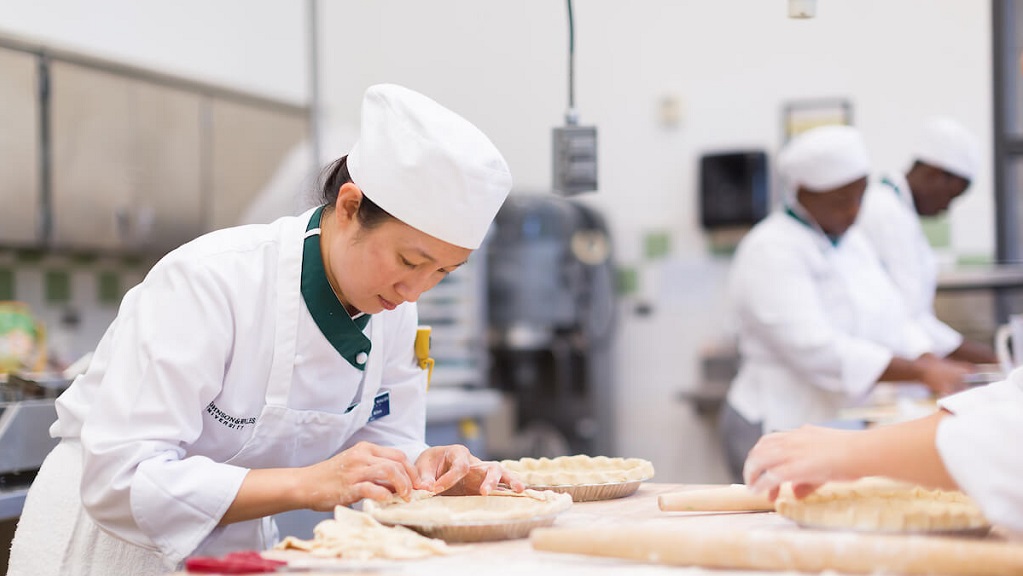
I’ve always admired cake decorator jobs because they combine creativity with hands-on craftsmanship. Watching decorators transform simple cakes into stunning designs showed me how much skill and patience the role requires. The job offers a unique opportunity to bring customers’ special celebrations to life through edible art.
Cake decorator jobs involve designing, decorating, and finishing cakes for birthdays, weddings, holidays, and other events. These positions require artistic ability, attention to detail, and knowledge of baking and decorating techniques.
Love creativity and baking? Cake decorator jobs let you turn ordinary cakes into memorable masterpieces for every celebration.
What Cake Decorator Jobs Actually Look Like in the Real World:

Most people picture a quiet bakery, soft music, and a decorator leisurely piping roses at a marble countertop. The reality? Cake decorator jobs in commercial settings are fast, physically demanding, and deadline-driven. You’re on your feet for eight to ten hours. Your lower back will know it.
The job title itself covers an enormous range. A decorator at a grocery chain like Kroger or Publix might spend most of their shift applying pre-made flowers and writing names in gel icing. A decorator at a boutique wedding cake studio is sculpting fondant figures, hand-painting edible gold leaf, and managing client consultations. Same job title. Completely different skill sets required.
Retail bakery cake decorator jobs make up the largest volume of openings nationally. The Bureau of Labor Statistics categorizes most of these roles under Bakers (SOC 51-3011), with median wages around $33,000–$42,000 annually depending on the employer and location. Specialty and luxury positions — the kind that require sugar pulling or advanced is malt work — can push salaries past $60,000 in major metropolitan markets.
Hospital cafeterias, hotel banquet departments, theme parks, cruise lines, and food manufacturing companies all hire for cake decorator jobs. It’s a wider field than most candidates realize, and each sector has its own rhythm.
The Core Skills Cake decorator jobs Screens For:

When hiring managers review applicants for cake decorator jobs, there’s a checklist running in their heads before the interview even starts. The non-negotiables aren’t always what you’d expect.
- Consistency under pressure — One beautiful cake means nothing if the next ninety come out uneven. Employers want proof you can replicate work at volume.
- Food safety certification — A current Serosae or equivalent certificate is increasingly required for cake decorator jobs at mid-to-large employers.
- Portfolio documentation — Photos are table stakes now. Video walkthroughs of complex cakes set serious candidates apart.
- Basic math and recipe scaling — Scaling a ganache recipe for 200 wedding cake tiers without calling your chef is an actual daily skill.
- Adaptability to house style — Chains want decorators who execute their templates flawlessly, not improvisers who freelance the design.
These five points separate applicants who get a first interview from those who don’t. Know where you stand on each before you apply.
Where Cake Decorator Jobs Are Actually Hiring Right Now:

The geography of cake decorator jobs in the US is uneven, and chasing openings without understanding regional demand is a waste of time. Let’s break this down properly.
Grocery retail accounts for nearly 40% of all active postings for cake decorator jobs at any given time. Kroger, Walmart Bakery, Publix, Whole Foods, and H-E-B post these positions continuously across their thousands of locations. The volume is high, turnover is real, and these employers hire fast.
1: Grocery Retail: The Highest-Volume Sector
Grocery cake decorator jobs offer predictable scheduling, benefits at larger chains, and union protections at some Kroger locations. The trade-off is creative constraint. You’re executing their catalog, not your portfolio.
Pay at this tier ranges from $15 to $22 per hour. Advancement into a Lead Decorator or Bakery Manager role is achievable within two to three years for strong performers.
2: Independent Bakeries and Wedding Studios
This is where artistry drives the work. Independent bakeries that specialize in custom orders — quinceañera cakes, elaborate birthday tiers, wedding designs that run $1,500 to $8,000 — need decorators who can handle client relations alongside the physical craft.
Cake decorator jobs at boutique studios often start lower in base pay but include commission structures, tip income, and the kind of portfolio-building work that opens doors to competitive markets like New York, Los Angeles, and Miami.
3: Corporate and Institutional Employers
Hotels, resorts, casinos, and theme parks all employ cake decorators as part of larger pastry teams. Walt Disney World’s pastry operation alone employs dozens of decorators. These cake decorator jobs tend to offer the most comprehensive benefits packages, the most structured advancement, and the most demanding production standards simultaneously.
4: The Growing World of Remote and Freelance Work
Teaching decorating classes online, selling custom cake toppers on Etsy, and creating tutorial content on YouTube have created a parallel economy around cake decorator jobs that didn’t meaningfully exist a decade ago. It’s not a replacement for employment, but it’s a real income supplement — and occasionally a full-time path for decorators with strong audiences.
How to Build a Portfolio That Opens Doors:
Applying for cake decorator jobs without a strong portfolio is like sending a resume with no work history. The visual evidence of your skill is the primary document in this field.
- Photograph everything — Natural light, neutral backgrounds, multiple angles. A phone camera is fine; bad lighting is not.
- Show process, not just product — A before/after or a step-by-step sequence demonstrates technical understanding, not just output.
- Include a range of techniques — Fondant work, buttercream textures, piping, hand-painted details, sugar flowers, and lettering should all appear somewhere in a competitive portfolio.
- Date your work — Employers want to see growth. A portfolio that shows visible improvement over two years is more compelling than a static collection of your ten best pieces.
- Match the portfolio to the job — Applying to a grocery chain? Lead with clean, consistent work. Applying to a wedding studio? Feature elaborate custom designs and client-specific work.
Tailoring your portfolio to each application category takes time, but it pays off. Generic portfolios get generic responses.
The Salary Landscape for Cake Decorator Jobs in 2025:
Pay for cake decorator jobs varies more than most people expect, and knowing the real numbers before you negotiate matters enormously.
Understanding your market value starts with disaggregating the data. National averages obscure huge regional swings and employer-type differences that directly affect what you should ask for.
1: Entry-Level Pay Realities
First-year cake decorator jobs — typically at retail bakeries or as assistants in custom shops — pay between $14 and $18 per hour in most US markets. In high cost-of-living cities like San Francisco, Seattle, or New York, this floor often runs $18 to $22 because local minimum wages and bakery competition for staff push rates up.
The honest reality: entry-level cake decorator jobs rarely cover rent alone in major metros without a second income or roommates. This is a field where you’re often paying your dues in your first 18 months, building skills that justify significantly higher pay later.
2: Mid-Career Pay Progression
Three to five years of experience at reputable employers — especially if that includes custom work, wedding cakes, or production management — shifts the range to $40,000 to $58,000 annually. At this stage, decorators who’ve added skills like sugar sculpture, chocolate work, or airbrushing command the higher end of that band without question.
3: Senior and Specialty Compensation
Lead decorators, head decorators, and pastry chefs with strong decorating specializations earn $55,000 to $80,000+ in premium markets. Executive pastry roles at luxury hotels or fine dining groups — where cake decorator jobs evolve into broader pastry production leadership — occasionally exceed $90,000 in cities like New York, Las Vegas, and Chicago.
Certifications and Education That Actually Move the Needle:
The question employers ask most often isn’t where you went to school. It’s what you can demonstrate. Still, certain credentials do accelerate hiring for cake decorator jobs in competitive markets.
- Culinary school completion — Degrees or diplomas from accredited programs (CIA, Johnson & Wales, Le Cordon Bleu US campuses) signal fundamentals. Not required, but respected.
- Wilton Method Certification — Widely recognized, accessible, and a genuine signal of foundational competency for entry-level cake decorator jobs.
- ICES membership and certification — The International Cake Exploration Société is the industry’s professional organization. Certified members get a credential that holds real weight in custom and competition circles.
- Competitions and awards — Winning or placing in recognized cake competitions (OSSAS, Wedding Cake World Cup, state fair competitions) is portfolio gold that money can’t buy.
- Food safety certifications — Serosae Manager certification is increasingly required for cake decorator jobs at employers with 50+ employees and is a cheap, fast credential to have.
Stacking two or three of these, combined with a strong portfolio, makes a candidate nearly impossible to overlook.
Comparison Tale: Cake Decorator Jobs by Employer Type (US Market, 2025) |
||||
| Employer Type | Avg Hourly Pay | Benefits | Creative Freedom | Advancement Path |
| Grocery Chain (Kroger, Publix, Walmart) | $15–$22/hr | Yes (medical, 401k at FT) | Low | Bakery Lead → Dept Manager |
| Independent Boutique Bakery | $14–$20/hr + tips | Rare | High | Senior Decorator → Co-Owner |
| Wedding Cake Studio | $16–$24/hr + commission | Sometimes | Very High | Head Designer → Studio Director |
| Hotel/Resort Pastry Dept | $18–$28/hr | Yes (comprehensive) | Medium | Pastry Sous Chef → Executive Pastry Chef |
| Theme Park / Entertainment | $17–$26/hr | Yes (strong) | Low–Medium | Lead Decorator → Pastry Supervisor |
| Food Manufacturing / CPG | $18–$25/hr | Yes (strong) | Very Low | Quality Lead → Production Manager |
| Freelance / Self-Employed | Variable ($25–$75/hr) | None (self-provided) | Total | Unlimited (client-driven) |
| Culinary School / Instructor | $20–$35/hr | Yes (if FT faculty) | Medium | Program Director |
How to Apply for Cake Decorator Jobs and Actually Hear Back:
Job boards are not enough. Cake decorator jobs — especially the best ones at boutique studios and high-end hotel properties — are often filled through referrals, Instagram DMs, and industry connections before a public listing ever goes up.
This doesn’t mean job boards are useless. Indeed, ZipRecruiter, LinkedIn, and Culinary Agents all carry legitimate volumes of cake decorator jobs postings. But treating those boards as your only strategy is leaving most opportunities on the table.
1: Building the Right Network
The decorating community is small and genuinely social. Instagram and TikTok are professional platforms in this industry, not just hobby spaces. Decorators who regularly post quality work, engage with peers, and tag local bakeries and event venues organically create relationships that lead to referrals for cake decorator jobs. This is documented. Bakery owners have publicly stated they check candidates’ feeds before calling for interviews.
Joining your regional American Culinary Federation chapter, attending cake shows and competitions as a spectator or exhibitor, and participating in online communities like Cake Central all build the kind of presence that generates introductions.
2: Crafting Your Resume for This Field
Keep it clean. One page unless you have significant tenure. List your certifications prominently. Link your portfolio — not just a generic social profile but a curated URL that goes directly to your best work. If you’ve worked with notable clients (even one recognizable local wedding venue or a well-known event planner), name them.
For cake decorator jobs at larger employers with HR departments, your resume often passes through ATS software before a human reads it. Use the actual job title from the posting, including keywords like “fondant,” “buttercream,” “wedding cakes,” and “custom orders” naturally throughout your experience descriptions.
Common Mistakes Candidates Make Applying for Cake Decorator Jobs:
Hiring managers see the same missteps repeatedly. Knowing them in advance is a genuine advantage.
- Submitting a portfolio with poor photography — A technically excellent cake photographed badly looks amateurish. Invest time in proper photo setup before you apply anywhere.
- Applying without researching the employer’s style — Sending a portfolio full of Baroque fondant sculpture to a minimalist, buttercream-only studio tells the employer you didn’t do your homework.
- Undervaluing food safety credentials — Skipping Serosae because “it’s just a bakery” has cost candidates cake decorator jobs at employers where certification is quietly mandatory.
- Failing to follow up — A single, professional email or LinkedIn message five to seven days after submitting an application is expected in this industry, not aggressive.
- Not asking about production volume in interviews — Discovering a studio’s weekly order volume after accepting the job is how people burn out in 90 days.
Avoiding these five mistakes puts you ahead of a meaningful percentage of the applicant pool.
Career Advancement Paths From Cake Decorator Jobs:
A first cake decorator job is not a ceiling. The decorating field connects to an entire ecosystem of adjacent roles and advancement ladders that many entry-level decorators don’t see clearly when they’re starting.
Cake decorator jobs feed into pastry arts in both directions: upward into leadership and specialization, and sideways into teaching, content creation, and entrepreneurship. Understanding those trajectories early lets you build deliberately toward them.
1: Moving Into Senior and Lead Decorator Roles
The jump from staff decorator to lead or senior decorator typically requires two to four years of consistent production work, demonstrated reliability, and some supervisory willingness. At larger operations, lead cake decorator jobs come with scheduling responsibilities, quality control ownership, and meaningful pay increases — often 20 to 35% above staff level.
2: Transitioning Into Pastry Chef Roles
Decorators with strong classical foundations — especially those who’ve pursued culinary education alongside their decorating work — frequently transition into broader pastry chef roles. This shift requires expanding your competency into viennoiserie, plated desserts, and chocolate work, but the labor market rewards it generously.
3: Teaching and Content Creation
Experienced decorators who communicate well have built significant businesses through class instruction. Local decorating classes at community centers, culinary schools, and dedicated cake studios generate $40 to $150 per student. Online platforms like Crafts, Skills are, and dedicated Patron communities have turned some decorators into six-figure educators whose income no longer depends on standing in a commercial kitchen.
4: Opening Your Own Studio
It happens more often than the pessimists claim. Decorators who’ve worked five to eight years across multiple employer types, built a client following, saved capital, and studied the business side — pricing, overhead, marketing, contracts — successfully open their own operations regularly. The failure rate for food businesses is real but not inevitable for people who plan carefully and start lean.
The Interview Process for Cake Decorator Jobs:
Walk in prepared for both a conversation and a skills test. Many employers — especially custom studios and hotel pastry departments — include a practical component in their interview process for cake decorator jobs.
Know your technique vocabulary cold. Being unable to explain the difference between Italian meringue and Swiss meringue buttercream in an interview for a premium studio is disqualifying. Have clear, specific answers for: What’s your production speed on a six-inch tiered cake? What’s the most technically complex piece you’ve completed? How do you handle a client who doesn’t like what they see at final pickup?
That last question matters enormously. Customer service is part of the job description in every custom-focused cake decorator position, and interviewers are listening for emotional intelligence, not just technical skill.
The Future of Cake Decorator Jobs in the US:
The market for cake decorator jobs is not shrinking. Custom cakes have become cultural centerpieces — not just for weddings but for gender reveals, graduations, corporate events, and social media content. The visual economy on platforms like Instagram and TikTok has expanded demand for elaborate, photogenic cakes in ways that weren’t predictable ten years ago.
Automation is a real factor at the production end. Frosting machines, piping robots, and AI-designed templates handle increasingly high volumes of the most repetitive work at large food manufacturers and some grocery chains. This doesn’t eliminate cake decorator jobs — it shifts which skills are most valued. Manual artistry, custom client work, and the kind of creative problem-solving that a machine can’t replicate are becoming more important, not less.
The decorators who’ll thrive through the next decade are those who combine traditional craft with digital fluency — photographers of their own work, marketers of their own brand, and students of the business as much as the art.
Your Next Three Steps Toward Landing Cake Decorator Jobs:
This is where most articles end with vague encouragement. Instead, here are three specific, actionable steps that move the needle on your search for cake decorator jobs.
Step one: Audit your portfolio this week. Identify the three weakest pieces and either reshoot them properly or remove them. A tighter, stronger collection beats a padded one every time.
Step two: Get your Serosae certification if you don’t have it. The exam is available online and in person. The cost is under $50 at most providers. Showing up to an interview for cake decorator jobs at any mid-to-large employer without current food safety certification in 2025 is an unforced error.
Step three: Introduce yourself to one new professional contact this week. It can be a local bakery owner, a decorator you follow online, or a culinary school instructor. Cake decorator jobs circulate through relationships before they ever get posted. Get into the conversation.
Summary
Cake decorator jobs span grocery retail, boutique studios, hotels, and freelance work across the US. Pay ranges from $14/hr. entry-level to $80,000+ at senior levels. Success requires a strong portfolio, food safety certification, and industry networking. Automation is reshaping production roles while elevating demand for skilled custom artistry and client-facing decorating expertise.
FAQ’s
Q1: Do I need culinary school to get cake decorator jobs?
No — a strong portfolio and verifiable skills matter more than formal credentials at most employers.
Q2: What is the average starting salary for cake decorator jobs?
Most entry-level positions pay between $14 and $18 per hour depending on employer type and location.
Q3: Are cake decorator jobs physically demanding?
Yes — expect extended standing, repetitive hand movements, and significant wrist strain over a full shift.
Q4: How do I find cake decorator jobs that aren’t posted on job boards?
Build a visible Instagram portfolio and reach out directly to local studios, hotels, and bakeries.
Q5: What’s the fastest growing segment for cake decorator jobs right now?
Custom event cakes and corporate celebration orders are driving the strongest hiring demand nationally.
Conclusion
Cake decorator jobs reward preparation, portfolio strength, and professional relationships above everything else. Get your certifications now, build a visually compelling body of work, understand which employer type fits your goals, and get into the conversations that precede the job listings. The opportunities are there for decorators who show up ready.